Agentic AI refers to AI systems that can plan, decide, and act with limited human input. Instead of only answering a question, an AI agent can break a task into steps, retrieve information, use tools, update systems, trigger workflows, and escalate when the situation falls outside defined limits.
Google Cloud describes AI agents as software systems that use AI to pursue goals and complete tasks on behalf of users. IBM also explains that agentic AI can obtain current data, optimize workflows, and create subtasks based on objectives, often using tools and APIs to complete more complex goals.
For enterprises, agentic AI is useful when a task requires more than a single answer. A customer may need an order status update, a refund request, an appointment change, or a payment reminder. An AI agent can understand the request, verify information, check business rules, update the right system, and complete the next step.
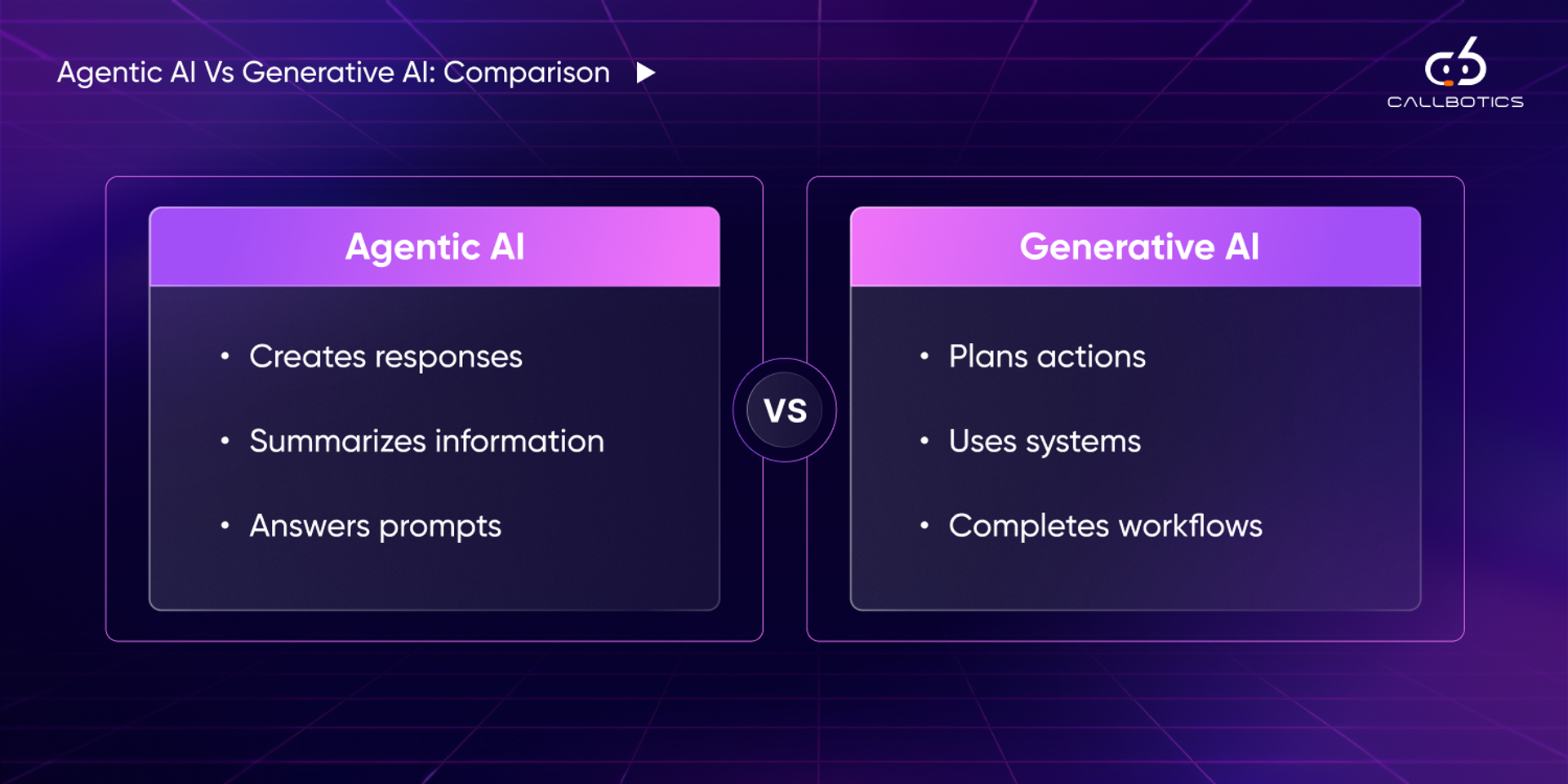
Generative AI produces output. Agentic AI completes tasks.
A generative AI system can draft an email, summarize a policy, or answer a question. An agentic AI system can use that same language capability to perform work across connected tools. McKinsey frames agentic AI around machines that do not just chat, but act, with the potential to reshape workflows, decision-making, and human-machine collaboration.
That difference matters in enterprise environments. A chatbot may tell a customer how to update an address. An AI agent can verify the customer, update the address in the CRM, confirm the change, and log the interaction.
Enterprise adoption is accelerating because AI agents are moving closer to real workflows. Leaders are not only asking whether AI can generate content. They are asking whether AI can reduce service cost, improve response time, resolve customer needs, and support teams at scale.
Three drivers are pushing adoption.
Enterprise companies are deploying agentic AI where work is repetitive, structured, measurable, and connected to existing systems. The strongest use cases are not vague “AI transformation” projects. They are focused workflows with clear inputs, decisions, actions, and outcomes.
The eight use cases below show where agentic AI is already becoming practical across enterprise operations.
Customer service is one of the clearest enterprise use cases for agentic AI. AI voice agents can handle inbound and outbound calls, verify callers, understand intent, retrieve account information, complete supported requests, send confirmations, update systems, and escalate when needed.
Common workflows include:
The important shift is from deflection to resolution. Older automation often pushed customers through menus or gave generic answers. Agentic AI voice agents can complete structured service requests when they are connected to the right data, workflows, and escalation rules.
Sales teams use agentic AI to handle first-touch qualification before human reps get involved. Instead of making reps manually chase every inquiry, AI agents can contact leads, ask qualification questions, score intent, capture requirements, update the CRM, and route qualified prospects to the right team.
Enterprise lead qualification often includes:
Agentic AI is useful here because sales qualification is structured but time-sensitive. A lead that waits too long may go cold. AI agents help teams respond quickly while keeping human reps focused on higher-intent opportunities.
IT help desks receive large volumes of repetitive Level 1 requests. Agentic AI can resolve many of these requests without human input by verifying the employee, checking permissions, triggering approved workflows, and updating the ticketing system.
Common IT help desk use cases include:
The best use cases are clearly governed. For example, an AI agent can handle password resets only after identity verification, policy checks, and approved system actions. More complex incidents can be routed to human IT teams with context attached.
HR teams use AI agents to answer employee questions, guide onboarding workflows, collect missing documents, and update HR systems.
Common workflows include:
Agentic AI works well in HR when answers need to be consistent and workflows need to be completed across systems. For example, an AI agent can answer a benefits question, send the right policy link, check whether an employee has completed required forms, and create a follow-up task if something is missing.
Finance teams use agentic AI for payment reminders, account verification, dispute intake, invoice follow-ups, and collections workflows. The value comes from scale, consistency, documentation, and faster follow-up.
Common finance and collections use cases include:
Agentic AI is not only about reducing manual calls. Finance workflows need careful tone, compliance, and accurate record-keeping. AI agents can follow approved scripts, capture outcomes, and escalate sensitive conversations to the right human team.
Healthcare organizations use AI agents to manage high-volume patient communication while maintaining compliance and consistent service.
Common healthcare workflows include:
Healthcare use cases require strict controls around privacy, identity verification, and escalation. AI agents are best suited for workflows where the logic is clear and the agent can follow approved pathways without making clinical decisions.
CallBotics highlights SOC 2 and HIPAA compliance on its contact page, which is especially relevant for enterprises evaluating AI voice workflows in compliance-heavy environments.
Insurance teams use agentic AI to support claims, renewals, policy servicing, and customer follow-ups. Many insurance interactions are structured, high-volume, and status-driven, which makes them a strong fit for AI agents.
Common insurance workflows include:
Agentic AI can collect information, validate required fields, update systems, and route complex cases to licensed or specialized teams. The safest deployments keep policy interpretation, sensitive disputes, and complex claim decisions under human control.
Supply chain and logistics teams use agentic AI to coordinate communication across customers, vendors, carriers, warehouses, and internal teams.
Common logistics use cases include:
Google Cloud’s 2026 real-world use case roundup includes Manhattan Associates’ Active Agents for warehouse management, transportation management, order management, and platform operations. These agents monitor work, resolve exceptions, guide users, automate tasks, and recommend actions to reduce manual effort.
For logistics teams, agentic AI is valuable because communication failures quickly create delays. AI agents can follow up at scale, confirm details, update systems, and flag exceptions before they become larger operational issues.
Agentic AI ROI is usually measured at the workflow level. Enterprise leaders want to know whether the deployment reduced cost, improved speed, increased resolution, lowered escalations, or improved quality.
Three metrics matter most:
Other useful metrics include escalation rate, average handle time, repeat contact rate, CSAT, QA coverage, turnaround time, deflection quality, and agent productivity.
The best agentic AI use case is usually not the most complex one. It is the workflow with enough volume, clear rules, measurable value, and reliable data access.
A strong first use case usually has four traits.
The task happens often enough to justify automation. Customer calls, password resets, appointment reminders, lead qualification, collections follow-ups, and status updates are good examples.
The workflow has clear decision paths. AI agents perform better when the process has defined rules, approved actions, and known escalation points.
The request follows a consistent pattern. Repetition makes it easier to train, test, measure, and improve the workflow.
The outcome can be tracked. Strong use cases have clear metrics such as resolution rate, cost per interaction, completion rate, escalation rate, or time saved.
A simple rule helps: start with workflows where a human team already follows a script, checklist, decision tree, or standard operating procedure.
For enterprises exploring agentic AI in voice operations, CallBotics helps turn high-volume calls into structured, measurable, resolution-focused workflows. Book a CallBotics demo to see where your first AI voice agent can fit.Enterprise agentic AI requires more than a good model. Successful deployment depends on data, integrations, controls, and adoption.
AI agents often handle customer records, employee data, financial information, or healthcare details. Enterprises need encryption, access controls, audit logs, retention policies, and vendor security documentation.
Agentic AI becomes useful when it can act inside real systems. Integrations with CRMs, ticketing tools, EHRs, billing systems, HRIS platforms, logistics tools, and knowledge bases determine whether the agent can complete the task or only answer questions.
Regulated industries need clear guardrails. AI agents should follow approved scripts, verify identity, document outcomes, escalate sensitive issues, and avoid unauthorized decisions.
Human teams need to understand what the AI agent handles, when it escalates, how performance is reviewed, and how work changes after deployment. Salesforce’s agentic enterprise playbook emphasizes preparing people for human-AI agent collaboration as part of the journey toward agentic operations.
Agentic AI can create real value, but weak deployment choices can limit results. Many failures happen because teams treat agentic AI as a model purchase instead of a workflow transformation.
Complex, low-volume, exception-heavy workflows are poor first deployments. Teams should begin with high-volume tasks where rules are clear and outcomes can be measured.
An AI agent that cannot access or update the right system will struggle to complete work. Integration testing should cover data retrieval, system updates, fallback paths, permissions, and error handling.
Agentic AI changes how work gets routed, reviewed, and escalated. Teams need training, performance dashboards, human ownership, and a clear process for improving the agent over time.
Gartner has warned that many agentic AI projects may be scrapped due to cost, unclear value, and hype-driven deployments, which reinforces the need for practical use case selection, integration planning, and measurable outcomes.
CallBotics powers agentic AI for enterprise voice by helping teams automate customer interactions through AI voice agents, workflow execution, integrations, summaries, QA, analytics, dashboards, and governed escalation.
The platform is built for enterprise-ready conversational AI and voice automation. CallBotics highlights 18+ years of contact center experience, around 80% call resolution or containment depending on use case, 48-hour workflow activation, 100% QA coverage, and 65–90% cost reduction depending on implementation.
CallBotics fits agentic AI use cases because voice interactions often require action, not just answers. A customer may need a claim update, payment reminder, appointment change, delivery confirmation, or account verification. CallBotics AI agents can follow structured workflows, connect to systems, complete supported requests, and escalate when a human should take over.
Key capabilities include:
Agentic AI is no longer only an experimental idea. Enterprise companies are already using AI agents to complete structured work across customer service, sales, IT, HR, finance, healthcare, insurance, and logistics.
The strongest deployments start with practical workflows: high-volume, rule-based, repeatable, measurable, and connected to real business systems. For voice use cases, CallBotics helps enterprise teams move from automation experiments to live customer interaction resolution with AI voice agents, analytics, QA, summaries, integrations, and governed escalation.

Urza Dey (She/They) is a content/copywriter who has been working in the industry for over 5 years now. They have strategized content for multiple brands in marketing, B2B SaaS, HealthTech, EdTech, and more. They like reading, metal music, watching horror films, and talking about magical occult practices.
See how enterprises automate calls, reduce handle time, and improve CX with CallBotics.
CallBotics is an enterprise-ready conversational AI platform, built on 18+ years of contact center leadership experience and designed to deliver structured resolution, stronger customer experience, and measurable performance.